

How long does brake caliper paint last through New Jersey winters? A professionally applied finish can often last several years, with around 3 to 5 years serving as a general industry estimate under normal use. But road salt, freezing temperatures, brake dust, and winter grime can affect how long your calipers maintain their original color and shine. The biggest factors are surface preparation, coating selection, application methods, and how well you maintain the finish.
If you live in North Jersey, you already know how messy winter roads can get. One day, your wheels look spotless. After a snowstorm, they’re covered in a gray mixture of salt, slush, and road grime.
Your brake calipers sit directly behind those wheels, where they face much of the same exposure.
The good news is that professionally painted brake calipers don’t automatically need repainting after every winter. With suitable coatings and regular cleaning, they can maintain their appearance through multiple seasons.
At TWC Wraps, we offer Brake Caliper Painting in Randolph, NJ | Dover & Morris County, NJ using careful surface preparation, high-temperature coatings, and protective finishing methods.
Let’s look at what affects paint longevity and how you can help your calipers withstand New Jersey’s winter conditions.
Table of Contents
- How Long Does Brake Caliper Paint Typically Last?
- Why Are New Jersey Winters Hard on Painted Brake Calipers?
- What Determines Brake Caliper Paint Longevity?
- Does Road Salt Damage Brake Caliper Paint?
- Professional Brake Caliper Painting vs DIY Paint
- How to Protect Painted Brake Calipers During Winter
- How Often Should You Wash Painted Brake Calipers?
- Signs Your Brake Caliper Paint Needs Attention
- When Should You Repaint Your Brake Calipers?
- Brake Caliper Painting in Randolph, NJ | Dover & Morris County, NJ
- Schedule Your Brake Caliper Painting Appointment
- Frequently Asked Questions
- Sources and References
How Long Does Brake Caliper Paint Typically Last?
If you’re asking how long brake caliper paint lasts through New Jersey winters, the answer depends on the type of coating and the condition of the calipers before painting.
A properly prepared, professionally painted caliper can maintain an attractive finish for several years.
Some automotive refinishing providers describe approximately 3 to 5 years as a typical lifespan for professional caliper paint under normal conditions. That estimate is not a guaranteed service life, and it should not be applied automatically to every coating or vehicle.
Some finishes last longer. Others show wear sooner, particularly when they experience repeated salt exposure, harsh cleaners, or poor surface preparation.
What About Daily-Use Vehicles?
A vehicle used throughout the year experiences more exposure than one stored during winter.
Think about a daily-use sedan traveling through Randolph, NJ, and Dover, NJ, after a snowstorm.
Its brakes may encounter wet salt residue, dirty slush, loose road grit, and changing temperatures during the same trip.
A weekend vehicle that stays inside during snowstorms may experience much less exposure.
The coating may be identical, but the conditions are not.
Does Brake Caliper Paint Last Longer Than One Winter?
Yes, a suitable and properly applied coating can last through multiple New Jersey winters.
Caliper-specific coatings are designed for demanding conditions, including heat and brake dust.
G2 USA, a manufacturer of caliper coating products, describes its two-part epoxy system as a durable finish with resistance to chipping, cracking, and peeling under its stated product terms.
That doesn’t mean all brake caliper paints perform the same way.
The manufacturer’s instructions, your vehicle’s brake design, surface condition, and maintenance habits still matter.
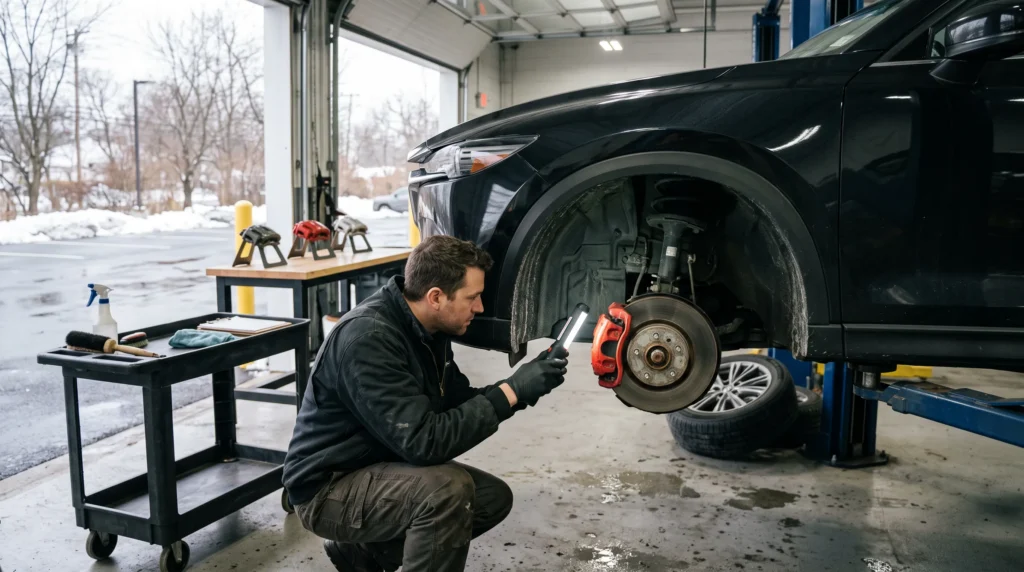
Bottom line: A professionally finished caliper should not be considered a one-winter modification, but no shop can promise an exact lifespan without accounting for the coating and how the vehicle is used.
Why Are New Jersey Winters Hard on Painted Brake Calipers?
New Jersey winters create a difficult environment for exposed automotive components.
Snow and freezing temperatures are only part of the problem.
Road treatment chemicals, moisture, grit, and repeated contamination can affect painted surfaces and exposed metal.
Road Salt and Salt Brine
The New Jersey Department of Transportation confirms that its winter maintenance operations use rock salt, salt brine, and calcium chloride solutions.
NJDOT also pretreats selected roads with brine before winter precipitation begins.
These materials help keep roads safer, but residue can collect around wheels, brake assemblies, and the underbody.
Once salt and moisture reach damaged or unprotected metal, corrosion becomes a concern.
Sand, Dirt, and Road Grit
Slush often contains more than melted snow.
Fine grit and dirt can collect on calipers, especially around exposed edges and recessed areas.
Loose abrasive material can contribute to surface wear. If the coating already has a chip or scratch, contamination can collect around that damaged spot.
Repeated Wet and Dry Conditions
During a New Jersey winter, your vehicle might encounter wet roads in the morning and dry pavement later in the day.
Salt residue may remain even after the visible water disappears.
A later storm or damp day can wet that residue again.
This repeated exposure matters because chloride contamination and moisture can contribute to corrosion of unprotected metal.
Heat From Braking
Brake calipers already work in an environment where temperatures rise and fall.
Winter adds colder starting temperatures and moisture to that setting.
A coating needs to be compatible with the heat generated around the braking system.
This is why ordinary decorative paint should not be treated as a substitute for a suitable caliper coating.
What Determines Brake Caliper Paint Longevity?
How long brake caliper paint lasts through New Jersey winters comes down to more than the number of snowstorms.
Several factors affect whether the finish stays attractive or begins showing early wear.
1. Surface Preparation
Surface preparation is one of the biggest differences between a lasting finish and one that starts peeling prematurely.
Before the coating goes on, the caliper surface needs to be assessed and cleaned.
Old brake dust, road contamination, grease, and loose finish material can interfere with coating adhesion.
Calipers with factory protective finishes also require care.
G2 USA notes that zinc-coated calipers need preparation suited to that surface so the paint can bond without unnecessarily removing the protective zinc layer.
The correct procedure depends on the brake manufacturer and coating product.
Painting over existing contamination may look acceptable at first, but it creates a weak foundation for the finish.
2. The Type of Coating
Not all paints are designed for brake components.
Some automotive coatings are intended for body panels, interior trim, or decorative accessories.
Brake calipers require materials compatible with the applicable temperatures and surface conditions.
Rust-Oleum’s Caliper Paint, for comparison, is formulated for brake dust exposure and temperatures up to 900°F.
That temperature rating applies to that product. It is not a universal rating for every caliper paint or a claim about the products used at TWC Wraps.
Ask your installer what coating system is appropriate for your vehicle.
3. Application and Curing
A suitable coating still needs to be applied correctly.
Layer thickness, drying conditions, preparation, and curing can affect the finished result.
Coating manufacturers have their own instructions.
Some systems include multiple coating stages, while others create the finished appearance without requiring a separate clear coat.
Do not assume adding more layers or an unrelated topcoat will make every product last longer.
The complete coating system needs to be compatible.
4. Vehicle Usage
A car exposed to salted roads several times each week may need more frequent cleaning than a vehicle rarely used in winter.
The condition of the roads matters too.
Wet, heavily treated pavement can leave residue around the wheel assemblies.
5. Cleaning Habits
A durable caliper finish still benefits from proper care.
Salt residue, brake dust, and grime should not be allowed to collect indefinitely.
Cleaning products matter just as much as cleaning frequency.
An aggressive chemical can damage a coating even when the caliper was painted correctly.
Does Road Salt Damage Brake Caliper Paint?
Road salt can contribute to paint deterioration and corrosion, especially when the coating is chipped or the underlying metal becomes exposed.
Salt does not necessarily strip a properly cured caliper coating the moment it touches the surface.
The concern comes from repeated exposure, trapped moisture, existing damage, and the condition of the protective finish.
The Federal Highway Administration explains that chloride-based road treatment chemicals can contribute to corrosion of motor vehicles and other metal structures.
Here’s why that matters for calipers.
Small Paint Chips Can Become Problem Areas
A tiny chip may not look serious.
But if it exposes metal, moisture and road salt can reach the unprotected area.
Corrosion may then begin around the damaged section.
Over time, the appearance can become worse if the underlying problem is left untreated.
Not every chip will spread, but it deserves attention.
Salt Buildup Can Hide Finish Problems
A caliper covered in winter residue may look dull or discolored even when the coating underneath is still intact.
Before assuming the paint has failed, clean it using a method approved for the finish.
After cleaning, you can better identify the difference between ordinary dirt, staining, and damaged coating.
Painted Calipers Are Not Rustproof
A cosmetic finish can provide a protective barrier on the surfaces it covers, but it does not make the entire brake assembly immune to corrosion.
Brake components include many different materials and surfaces.
Some areas must remain free of paint for mechanical or safety reasons.
That is why regular brake inspections remain necessary even when the visible calipers look clean.
Professional Brake Caliper Painting vs DIY Paint: Which Lasts Longer?
One question often comes up when owners compare brake caliper painting options: is a professional finish more likely to survive winter than a DIY job?
The application method matters, but the label alone does not guarantee longevity.
A properly prepared DIY coating can perform well when the correct product and instructions are followed.
A poorly prepared professional job can fail early.
The difference comes from what happens before, during, and after the coating is applied.
DIY Brake Caliper Painting
DIY projects often involve cleaning the visible caliper surfaces, masking surrounding components, and applying a caliper-specific paint.
Common challenges include limited access, incomplete cleaning, unsuitable coating selection, and insufficient curing time.
Brake work also carries safety concerns.
The calipers sit near hydraulic fittings, brake pads, rotors, seals, and mounting surfaces that must not be coated improperly.
A cosmetic project should never interfere with the braking system.
Professional Brake Caliper Painting
A professional service can provide dedicated preparation, access to the calipers, controlled application, and a planned finishing process.
At TWC Wraps, our published Brake Caliper Painting service includes wheel removal, caliper cleaning, protective masking, high-temperature coatings, and a protective topcoat suited to the selected process.
That preparation matters when thinking about how long brake caliper paint lasts through New Jersey winters.
The goal is a neat, consistent finish with the proper handling of nearby components.
A Note About Manufacturer Restrictions
Some manufacturers have restrictions involving refinishing.
Brembo’s official partner Race Technologies states that Brembo does not recommend repainting its calipers because improper work can create problems.
Its guidance warns against powder coating, unnecessary disassembly, and coating certain mounting surfaces.
If your vehicle has a Brembo or other manufacturer-specific performance braking system, consult the applicable instructions before planning cosmetic refinishing.
No paint color is worth compromising brake safety.
How to Protect Painted Brake Calipers During Winter
You cannot completely avoid road salt if your vehicle is used throughout a New Jersey winter.
You can still reduce how long residue stays on the vehicle and avoid cleaning methods that damage the finish.
Rinse Away Winter Road Residue
After traveling on heavily treated roads, plan to remove the salt and grime from your wheels and surrounding areas.
Use clean water and washing methods suitable for your vehicle and brake components.
Do not place your hands near hot brake assemblies.
Allow the brakes to cool before cleaning, and avoid spraying concentrated high-pressure water directly into sensitive components.
Choose Gentle Cleaning Products
Harsh acidic wheel cleaners can damage certain caliper finishes.
Race Technologies’ Brembo GT maintenance guidance advises cleaning the braking components covered by its instructions with soap and water instead of acidic wheel cleaners.
For TWC Wraps caliper painting, follow the aftercare recommendations provided for the installed coating.
Do not assume that a wheel cleaner suitable for one finish is appropriate for every painted caliper.
Use Soft Cleaning Tools
A soft, clean brush or microfiber tool can help remove dirt from accessible surfaces when approved for the finish.
Avoid stiff wire brushes, abrasive pads, and aggressive scrubbing.
Those tools may damage the paint surface.
Never put your fingers or cleaning equipment inside brake assemblies when the vehicle is moving or the brakes are hot.
Check for Chips After Winter Storms
Once the calipers are clean, look for damage around visible faces and edges.
Small chips, peeling, bubbling, and corrosion stains deserve attention.
Do not attempt to paint over leaking or damaged brake components.
Give the Vehicle a Thorough Spring Cleaning
When winter ends, remove the remaining grime from the wheels, wheel wells, and underbody.
That final cleaning can help prevent salt residue from lingering into warmer weather.
For owners who want help maintaining the rest of the vehicle, TWC Wraps provides Premium Auto Detailing and Premium Exterior Detailing.
Tell the detailing team about any custom caliper coating so the proper cleaning products can be discussed.
How Often Should You Wash Painted Brake Calipers?
You do not need to clean your painted calipers after every short trip.
But during the winter, waiting months between washes can leave road residue sitting on the finish.
Consumer Reports recommends washing vehicles monthly during snowy weather, or more often when salt buildup is visible. Its winter advice also recommends paying attention to wheels and the undercarriage.
AAA recommends washing at least every two weeks during salt exposure, with more frequent cleaning after heavily salted road conditions.
Those are general vehicle maintenance recommendations rather than special service intervals for painted calipers.
For owners in Randolph, NJ, Dover, NJ, and nearby Morris County communities, a practical routine looks like this:
Before Winter
- Wash the wheels and inspect the painted calipers.
- Look for chips, peeling, or existing corrosion.
- Follow the shop’s instructions if the coating is newly applied.
- Ask a professional about any visible damage before heavy salt exposure begins.
During Winter
- Wash the vehicle regularly when conditions allow.
- Give attention to wheel wells and areas exposed to road salt.
- Use cleaning products appropriate for the caliper finish.
- Avoid aggressive brushes or harsh chemicals.
- Check for new chips during routine washing.
After Winter
- Remove remaining salt residue from the vehicle.
- Inspect painted caliper surfaces in good lighting.
- Check for changes in gloss, color, or coating adhesion.
- Arrange an inspection if you notice peeling or corrosion.
Wait for a suitable wash day when temperatures are above freezing, and make sure the brake components have cooled.
This routine cannot guarantee that a coating will last a certain number of years, but it can help reduce preventable damage.
Signs Your Brake Caliper Paint Needs Attention
How do you know whether your calipers simply need cleaning or whether the finish is beginning to wear out?
Start with what you can see after the surfaces have been washed and dried.
Faded or Dull Color
A red caliper that once looked glossy might become dull over time.
Before assuming the coating has faded, remove surface brake dust and grime.
If the color still looks uneven after cleaning, the finish may be showing cosmetic wear.
Chipped Paint
Small chips can result from road debris, contact, or other surface damage.
Chips that expose metal deserve attention because moisture and salt may reach the underlying surface.
Peeling or Flaking
Peeling paint is a stronger sign that the coating is no longer adhering properly.
Possible reasons include preparation problems, an incompatible coating system, contamination, or damage that began at an exposed edge.
The cause should be assessed before repainting.
Rust Around Painted Areas
Rust staining near a painted caliper does not always mean the coating itself has failed.
Brake assemblies contain several metal components, and not every surface is painted.
A qualified technician should determine whether the rust is cosmetic or connected to a mechanical problem.
Bubbling Beneath the Finish
Bubbling can indicate that the coating is losing adhesion or that corrosion is developing beneath it.
Do not simply cover a blistered area with more paint.
The surface needs to be inspected and prepared before refinishing.
Uneven Appearance Between Wheels
Front and rear calipers can experience different amounts of dirt and heat exposure.
If one caliper looks noticeably different from the others, check whether it needs cleaning or further inspection.
A change in appearance alone does not prove that the caliper has a mechanical problem.
When Should You Repaint Your Brake Calipers?
There is no automatic rule requiring caliper repainting after two winters, three winters, or any other fixed period.
The condition of the coating matters more than the calendar.
If your calipers remain clean, evenly colored, and free of peeling, there may be no cosmetic reason to repaint them.
If the finish has developed chips, stains that cannot be removed safely, or widespread peeling, professional refinishing may be worth discussing.
Can You Paint Over Old Brake Caliper Paint?
In some situations, a compatible coating can be applied over an existing finish after suitable preparation.
That does not mean every old paint layer should be covered.
Loose or failing paint can undermine the new coating.
The brake manufacturer’s restrictions, existing surface, and chosen coating instructions should determine whether refinishing is appropriate.
Should You Repaint Before or After Winter?
A project completed before winter gives you the appearance you want heading into the season.
It also means the new coating will face winter conditions relatively soon.
If scheduling allows, many owners may prefer having cosmetic work completed when the shop can provide suitable application and curing conditions.
Professional facilities can control parts of the working environment, so the season alone does not determine whether painting is possible.
The coating must be given the curing time required by its manufacturer before being exposed to washing or demanding conditions.
Does Repainting Repair Rusted Calipers?
No. Cosmetic painting is not a replacement for brake repair.
A caliper with a seized piston, leaking seal, damaged hydraulic fitting, or another mechanical concern needs proper brake service.
If your vehicle pulls when braking, shows a brake warning light, or develops unusual pedal behavior, have it examined by a qualified brake technician.
Brake Caliper Painting in Randolph, NJ | Dover & Morris County, NJ
New Jersey vehicle owners have plenty of reasons to care about keeping their wheels and calipers looking good.
A freshly painted set of calipers can add personality to a luxury sedan, Tesla, SUV, sports car, or daily-use vehicle.
But appearance is only one part of the project.
Preparation and coating compatibility matter, particularly when the vehicle will be used on salted roads throughout winter.
At TWC Wraps, we provide Brake Caliper Painting in Randolph, NJ | Dover & Morris County, NJ for vehicle owners who want custom colors and a clean finish.
Our published caliper painting process includes removing the wheels, preparing the visible caliper surfaces, protecting surrounding brake components, and using coatings designed for elevated temperatures.
Serving Randolph, Dover, and Morris County
TWC Wraps is located at:
1248 Sussex Turnpike, Suite B-2, Randolph, NJ 07869
We serve vehicle owners from Randolph, NJ, Dover, NJ, and communities throughout Morris County, NJ, including:
- Denville, NJ
- Rockaway, NJ
- Morristown, NJ
- Morris Plains, NJ
- Wharton, NJ
- Parsippany-Troy Hills, NJ
- Roxbury, NJ
- Chester, NJ
- Boonton, NJ
- Mount Olive, NJ
Whether you’re preparing your vehicle for winter or refreshing its appearance after the season, our team can discuss the caliper color options available for your make and model.
Pair Caliper Painting With Other Vehicle Customization Services
Caliper color can work well with other appearance upgrades.
A bright caliper finish behind dark wheels may look great alongside a custom body color or darker exterior accents.
TWC Wraps also provides:
- Vinyl Wrap for exterior color changes and custom styling.
- Chrome Delete for a darker appearance around exterior trim.
- Window Tint for appearance and cabin comfort.
- Paint Protection Film for eligible painted exterior body surfaces.
- Ceramic Coating for compatible exterior surfaces.
- Premium Auto Detailing for routine vehicle appearance care.
Paint protection film and exterior ceramic coating services should not be assumed suitable for brake calipers. These are separate vehicle appearance services.
TWC Wraps is a certified STEK shop for its applicable STEK services. STEK product warranties should not be confused with coverage for caliper painting.
You can view our full list of automotive services when planning your project.
Schedule Your Brake Caliper Painting Appointment
So, how long does brake caliper paint last through New Jersey winters?
For a professionally applied finish, several years is a reasonable expectation to discuss with an installer. Industry estimates around 3 to 5 years are useful reference points, but actual results can differ.
A vehicle that spends winter on heavily salted roads may show cosmetic wear sooner than one that rarely sees snow or slush.
The condition of the calipers, selected coating, preparation, curing, and cleaning habits all play a role.
If you’re considering caliper painting, the best starting point is to talk with a shop about your vehicle and how you use it.
At TWC Wraps, we can discuss your caliper condition, color preferences, available finishing options, and care instructions.
TWC Wraps Contact Information
Address: 1248 Sussex Turnpike, Suite B-2, Randolph, NJ 07869
Phone: (201) 575-0184
Hours: Tuesday through Sunday, 8:30 AM to 5:30 PM
Monday: By appointment only
Website: https://twcwraps.com
Call (201) 575-0184 or visit our contact page to request an appointment for Brake Caliper Painting in Randolph, NJ | Dover & Morris County, NJ.
Frequently Asked Questions
1. How long does brake caliper paint last through New Jersey winters?
A professionally prepared and coated caliper can maintain its appearance for several years. Around 3 to 5 years is a general industry estimate under normal use, not a guaranteed lifespan. Winter road salt, coating selection, preparation, cleaning habits, and existing caliper condition affect how long the finish lasts. Some coatings may last longer, while others need attention sooner.
2. Will road salt make painted brake calipers peel?
Road salt does not automatically cause a properly applied coating to peel, but repeated salt and moisture exposure can contribute to corrosion where the finish is chipped or damaged. Poor adhesion, unsuitable coatings, and harsh cleaning products can also cause paint failure. Regular cleaning and prompt inspection of damaged areas can help preserve the finish.
3. Should I wash my painted brake calipers after every snowstorm?
You do not need to wash them after every short trip, but removing heavy salt buildup promptly is a good habit. AAA recommends vehicle washing at least every two weeks during winter salt exposure, or more often when roads are heavily treated. Use a cleaning method appropriate for your caliper coating and make sure the brakes are cool before washing.
4. Can painted brake calipers rust underneath the coating?
Yes. If moisture and road salt reach exposed metal through chips, scratches, or failing coating, corrosion can develop. Painting does not make brake assemblies completely rustproof. If you notice bubbling, peeling, or rust staining, arrange an inspection to determine whether the issue is cosmetic or mechanical.
5. Is professional brake caliper painting better for winter durability?
Professional painting can offer advantages through careful cleaning, preparation, masking, and coating application. But the results depend on the shop’s actual methods and materials. A professionally applied finish still needs proper maintenance, and no coating can guarantee complete resistance to winter wear. Ask about the process and any applicable workmanship terms before booking.
6. Can brake caliper paint be touched up instead of completely repainted?
Some small areas may be candidates for touch-up using a compatible product and suitable preparation. Widespread peeling, bubbling, or corrosion may require more extensive refinishing. The existing finish and brake manufacturer’s instructions should be reviewed before applying new paint. Never cover a mechanical brake problem with a cosmetic coating.
7. Where can I get brake caliper painting in Randolph, NJ | Dover & Morris County, NJ?
TWC Wraps provides Brake Caliper Painting in Randolph, NJ | Dover & Morris County, NJ at 1248 Sussex Turnpike, Suite B-2, Randolph, NJ 07869. We serve vehicle owners from Dover, Denville, Rockaway, Morristown, Parsippany-Troy Hills, and other nearby communities. Call (201) 575-0184 or visit https://twcwraps.com/contact-us/ to discuss your vehicle and schedule an appointment.
Sources and References
The sources below support the information about coating durability, winter road treatments, corrosion, cleaning methods, and brake-system safety.
1. New Jersey Department of Transportation
Title: Winter Readiness: Frequently Asked Questions
Publisher: New Jersey Department of Transportation
Publication Date: Not listed
URL: https://www.nj.gov/transportation/about/winter/faq.shtm
Reference: New Jersey road salt, salt brine, calcium chloride, and winter road pretreatment practices.
2. Federal Highway Administration
Title: FHWA Environmental Technology Brief
Publisher: Federal Highway Administration, U.S. Department of Transportation
Publication Date: 1998
URL: https://www.fhwa.dot.gov/publications/research/infrastructure/structures/98079/index.cfm
Reference: Chloride-based deicing chemicals and corrosion involving motor vehicles and infrastructure.
3. Consumer Reports
Title: How Often Should You Wash Road Salt Off Your Car?
Publisher: Consumer Reports
Publication Date: Updated February 13, 2026
URL: https://www.consumerreports.org/cars/how-often-should-you-wash-road-salt-off-your-car-a7227523841/
Reference: Winter vehicle washing frequency, salt removal, wheel cleaning, and undercarriage care.
4. AAA
Title: AAA Warns Drivers: Winter Road Salt Can Cause Hidden Vehicle Damage
Publisher: AAA, The Auto Club Group
Publication Date: February 18, 2026
URL: https://newsroom.acg.aaa.com/aaa-warns-drivers-winter-road-salt-can-cause-hidden-vehicle-damage/
Reference: Winter salt damage, corrosion risks, and recommendations for regular vehicle washing.
5. G2 USA
Title: Frequently Asked Questions About G2 Brake Caliper Paints
Publisher: G2 USA
Publication Date: Not listed
URL: https://g2usa.com/pages/faqs
Reference: Caliper coating preparation, painted and zinc-coated surfaces, adhesion, and manufacturer product performance terms.
6. Rust-Oleum
Title: Caliper Paint
Publisher: Rust-Oleum
Publication Date: Not listed
URL: https://www.rustoleum.com/product-details/consumer-brands/auto/specialty-paints/caliper-paint
Reference: Caliper-specific paint properties, brake dust resistance, heat rating, and preparation requirements.
7. Race Technologies
Title: Repainting of Calipers
Publisher: Race Technologies, Official Brembo Partner
Publication Date: Not listed
URL: https://www.racetechnologies.com/article/repainting-calipers-0
Reference: Brembo caliper refinishing restrictions, coating methods, protected surfaces, and brake-system safety.
8. Race Technologies
Title: Important Brembo GT System Post-Installation Notes
Publisher: Race Technologies, Official Brembo Partner
Publication Date: Not listed
URL: https://racetechnologies.com/article/important-brembo-gt-system-post-installation-notes-909521
Reference: Recommended cleaning practices and warnings about acidic wheel cleaners and caliper finish damage.
9. Bumper Buddies
Title: How Long Does Mobile Caliper Painting Last? Durability, Care, and What to Expect Over Time
Publisher: Bumper Buddies Orange County
Publication Date: March 18, 2026
URL: https://bumperbuddies.com/orange-county/blog/2026/03/18/how-long-does-mobile-caliper-painting-last-durability-care-and-what-to-expect-over-time/
Reference: Industry provider’s general three-to-five-year estimate for professional caliper painting under normal conditions. Not a controlled New Jersey winter study or TWC Wraps warranty.
10. TWC Wraps
Title: Brake Caliper Painting in Randolph, NJ | Dover & Morris County, NJ
Publisher: TWC Wraps
Publication Date: Not listed
URL: https://twcwraps.com/services/brake-caliper-painting/
Reference: TWC Wraps service process, coating approach, preparation methods, service areas, and contact information.
Safety Note: Brake caliper painting is a cosmetic service. Brake manufacturer instructions take priority over general refinishing advice. Any suspected mechanical brake problem should be inspected by a qualified technician before cosmetic work is considered.
