

Starlight headliner care is one of the easiest ways to protect the appearance of your custom fiber-optic roof. A starlight headliner can turn an ordinary vehicle interior into a glowing night sky, but keeping it clean requires a different approach than wiping down your dashboard or vacuuming your seats. The tiny fiber-optic strands, delicate roof fabric, and hidden lighting components all deserve careful attention.
The good news? Maintaining a starlight headliner does not have to be complicated.
Most routine maintenance involves removing dust, gently treating small marks, keeping moisture away from electrical components, and avoiding harsh cleaning products. The trick is knowing what to clean, what to leave alone, and when to ask a professional for help.
At TWC Wraps, we provide Starlight Headliner Installation in Randolph, NJ | Dover & Morris County, NJ for vehicle owners who want a custom interior lighting experience. Whether you recently installed a starlight roof or have enjoyed yours for years, this guide will help you understand how to care for it.
Table of Contents
- Understanding How a Fiber-Optic Starlight Headliner Works
- Why Proper Starlight Headliner Care Matters
- What You Need to Clean a Starlight Headliner
- How to Clean a Starlight Headliner Step by Step
- How to Remove Stains From a Starlight Headliner
- Cleaning Different Starlight Headliner Materials
- Starlight Headliner Cleaning Mistakes to Avoid
- How to Maintain Fiber-Optic Lights and Controls
- How Often Should You Clean Your Starlight Headliner?
- When Should You Get Professional Help?
- Starlight Headliner Care in Randolph, NJ
- Schedule Your Starlight Headliner Consultation
- Starlight Headliner Care FAQs
Understanding How a Fiber-Optic Starlight Headliner Works
Before getting into starlight headliner care, it helps to understand what makes this type of ceiling different from an ordinary automotive headliner.
A starlight headliner uses individual fiber-optic strands to create small points of light across the roof. These strands carry light from an illuminator, sometimes called a light engine, to their visible ends in the ceiling.
The fibers themselves are not individual electrical bulbs. Light travels through the strands, creating the appearance of stars scattered across the headliner.
Rolls-Royce Motor Cars describes its factory Starlight Headliner as a system using hundreds of individually positioned fiber-optic lights.
Aftermarket starlight headliners use a similar fiber-optic lighting concept, though the installation method and components can differ.
Depending on the system, your roof may offer:
- Adjustable star brightness
- Multiple lighting colors
- Twinkling star effects
- Shooting-star patterns
- Remote or app-based controls
- Music-responsive lighting modes
These features make the ceiling look impressive, but they also explain why starlight headliner care should involve more than ordinary interior cleaning.
Why Proper Starlight Headliner Care Matters
A custom starlight roof combines two things that require attention: interior upholstery and lighting equipment.
The visible fabric can collect dust, fingerprints, or accidental stains. Meanwhile, the installed fiber ends need to remain in position for the star pattern to look the way it was designed.
Here is why proper maintenance matters.
Protecting the Headliner Fabric
Automotive headliners are often constructed from layers of fabric, foam, and backing material. Some luxury interiors use suede-like materials or Alcantara.
Heavy scrubbing can damage the surface. Excessive moisture can also affect certain headliner materials and the adhesive holding them together.
Volvo’s headliner cleaning guidance warns against scraping, rubbing stains, and using strong stain removers.
That advice is useful for starlight headliner care because the material has already been modified to accommodate fiber-optic strands.
Keeping the Star Pattern Intact
Every visible point of light is part of the finished design.
Pulling a fiber, catching one with a stiff brush, or trimming a visible strand can change the appearance of the roof.
The goal is to remove surface dirt without disturbing the star points.
Avoiding Moisture Around Lighting Components
The visible fiber-optic strands carry light, but the system still has electrical equipment that powers the effect.
Liquid entering a lighting module, wiring connection, or controller can create problems.
A slightly damp cloth may be suitable for certain headliner fabrics. Pouring cleaner onto the roof or saturating the surface is a different matter.
What You Need to Clean a Starlight Headliner
You do not need a large collection of detailing products for routine starlight headliner care.
In most cases, a few gentle tools are enough.
Recommended Cleaning Supplies
- Clean microfiber cloths: Use soft, lint-free cloths for dry dust removal and light surface cleaning.
- Soft detailing brush: A very soft brush may help remove loose dust from compatible fabric areas.
- Clean water: A small amount may be appropriate for fabrics that allow damp cleaning.
- Manufacturer-approved upholstery cleaner: Only use a product confirmed to be suitable for your particular headliner material.
- A second dry cloth: Keep one available for absorbing remaining moisture.
Always check the care instructions supplied by your installer and the manufacturer of your headliner material.
Avoid assuming that a cleaner suitable for leather seats, door panels, or carpeting is also suitable for the ceiling.
The safest starting point is a clean, dry cloth.
How to Clean a Starlight Headliner Step by Step
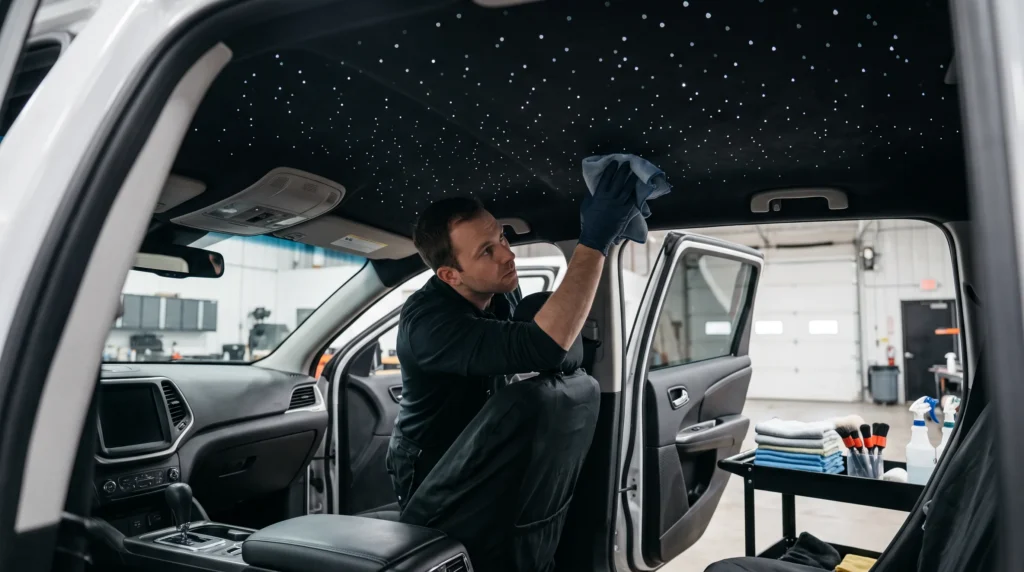
Wondering how to clean a starlight headliner without damaging the fabric or fiber-optic lights?
Follow a gentle process and avoid rushing.
Step 1: Turn Off the Starlight Lighting
Begin with the vehicle parked and the starlight system switched off.
Make sure the roof has not been exposed to excessive heat and that you have enough daylight or cabin lighting to see the surface clearly.
Turning off the lights also makes it easier to notice marks, dust, or fabric discoloration without colored lighting affecting your view.
You do not need to disconnect any wires or remove interior panels for routine surface cleaning.
Step 2: Inspect the Headliner
Look across the ceiling before touching it.
Check for:
- Loose dust
- Small fingerprints
- Visible staining
- Sagging or loose fabric
- Fiber ends sticking out unusually far
- Moisture marks
- Changes around overhead trim
If you notice loose fibers, wet areas, or damaged material, do not scrub the affected section.
Ask your installer to inspect it first.
Step 3: Gently Remove Surface Dust
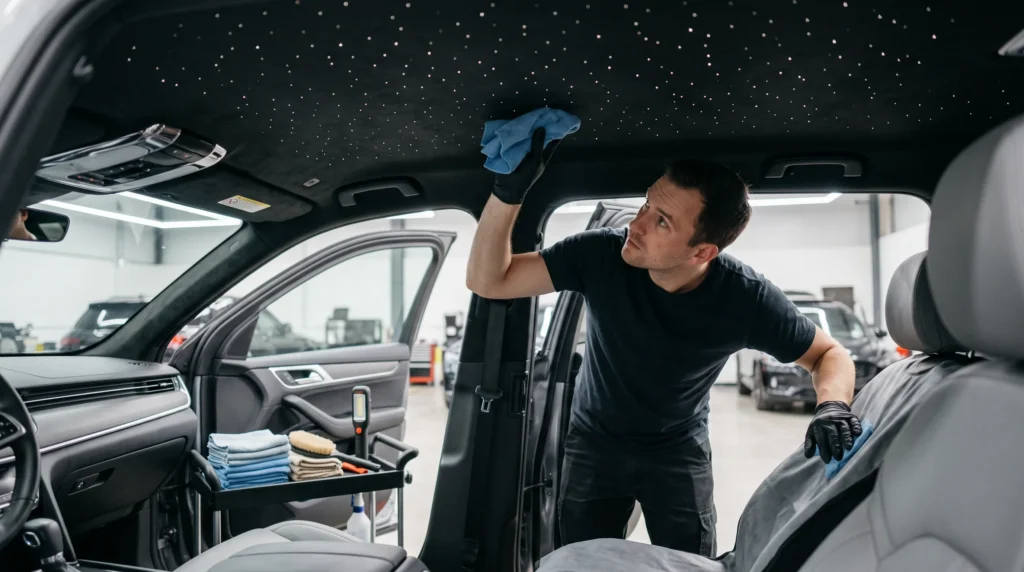
For ordinary dust, start with a clean, dry microfiber cloth.
Lightly pass the cloth over the fabric without pressing hard.
Work in small sections rather than trying to clean the entire ceiling in one movement.
If the material allows brushing, use a very soft brush with minimal pressure. Avoid brushing directly across raised or exposed fiber tips that could catch on the bristles.
This is where starlight headliner care differs from ordinary carpet cleaning. You want to lift away surface dust rather than work deeply into the material.
Step 4: Treat Small Marks Carefully
If dry cleaning does not remove a mark, check the material-specific cleaning instructions.
Some fabrics allow a cloth that has been lightly moistened with clean water.
For an approved damp-cleaning method:
- Moisten a clean cloth rather than the headliner.
- Wring it out thoroughly.
- Test an inconspicuous area first.
- Gently blot the mark.
- Avoid rubbing across fiber ends.
- Use a dry cloth to absorb remaining surface moisture.
Stop if the material changes color, develops a water ring, or begins to look disturbed.
Do not keep adding liquid in an attempt to remove a stubborn stain.
Step 5: Let the Surface Dry Naturally
If damp cleaning was permitted and used, allow the surface to dry fully.
Keep the interior ventilated when practical. Avoid directing a heat gun, hair dryer, or steamer at the headliner.
High heat can damage certain upholstery materials and is not an appropriate shortcut for drying a custom fiber-optic ceiling.
Step 6: Check the Lighting
Once the headliner is completely dry, switch the starlight system back on.
Look at the roof from different seating positions.
Check whether the visible stars appear as expected and whether the controls respond normally.
If your system supports color changes, dimming, or twinkling effects, check the functions you normally use.
If something looks different after cleaning, contact the installer instead of pulling at fibers or opening the roof.
How to Remove Stains From a Starlight Headliner
Stains require more care than ordinary dust.
A starlight headliner can be affected by accidental drink splashes, dirty hands, cosmetics, or contact with objects placed too close to the ceiling.
The most useful habit is responding early without making the affected area wetter.
Handling a Fresh Spill
If liquid reaches the headliner, gently absorb what you can with a clean, lint-free cloth.
Do not press so hard that liquid is forced deeper into the material.
Avoid spraying additional cleaner directly onto the wet area.
If liquid may have entered the lighting system, leave the equipment switched off and arrange an inspection.
Dealing With a Dried Stain
A dried stain may require a cleaning method suited to the fabric.
Different headliner materials respond differently to water and upholstery products.
Alcantara’s stain removal instructions recommend avoiding vigorous rubbing, treating stains carefully, and applying cleaning products to a cloth rather than pouring them directly onto the material.
Those recommendations are worth remembering, but they should not be treated as universal instructions for every automotive fabric.
For an unfamiliar stain, professional advice is safer than experimenting with several cleaning chemicals.
Why Scrubbing Usually Makes Things Worse
Scrubbing can spread a stain across the surface, disturb the fabric texture, or catch an exposed fiber.
You may end up with a larger mark than the one you started with.
For starlight headliner care, gentle blotting and material-approved cleaning are better starting points than aggressive brushing.
Cleaning Different Starlight Headliner Materials
Not every starlight roof uses the same upholstery.
The cleaning method should follow the actual material installed in your vehicle.
Fabric Starlight Headliners
Many automotive headliners use a soft woven or knitted fabric.
For these surfaces, remove loose dust first and avoid applying too much pressure.
Do not use carpet shampoo machines or extraction equipment on the roof unless a qualified professional has assessed the material and the fiber-optic installation.
If you are unsure which cleaner belongs on your headliner, ask the installer before applying anything.
Alcantara Starlight Headliners
Alcantara has its own published maintenance instructions.
The manufacturer recommends removing ordinary dust with a soft brush, dry cloth, or vacuum cleaner. For routine care, it also describes using a slightly moistened white cotton cloth.
The manufacturer warns against strong rubbing, excessive moisture, steam cleaning, bleach, and aggressive solvents.
Read the full Alcantara cleaning and maintenance guide before treating the material.
A fiber-optic Alcantara roof deserves extra caution around its installed star points. Do not let a brush or vacuum attachment catch the fibers.
Suede-Like and Custom Upholstery
Some headliners have a suede-like appearance without being genuine suede or Alcantara.
They may have different cleaning requirements.
Do not choose a cleaning product based only on how the surface looks or feels.
If your roof was reupholstered during installation, ask which material was used and whether special maintenance instructions apply.
That information can save you from using a cleaner that changes the texture or leaves a visible mark.
Starlight Headliner Cleaning Mistakes to Avoid
Good starlight headliner care is partly about knowing what not to do.
Some common interior detailing methods are too aggressive for a custom fiber-optic roof.
1. Spraying Cleaner Directly Onto the Ceiling
Spraying liquid overhead makes it harder to control how much reaches the surface.
The cleaner may enter the fabric backing, trim openings, or areas around the installed fibers.
Apply approved cleaning solutions to a cloth instead, and use the least moisture needed.
2. Using a Steam Cleaner
Steam introduces heat and moisture.
Alcantara advises against steam machines, and delicate headliner materials can be damaged by unsuitable cleaning methods.
Avoid steam cleaning a fiber-optic headliner unless its material manufacturer and installer have explicitly approved a procedure.
3. Scrubbing With Hard Brushes
Stiff bristles can disturb fabric texture and catch fiber ends.
A brush that works well on floor mats or rubber trim does not belong on a delicate roof lining.
4. Using Strong Household Cleaners
Bleach, strong solvents, abrasive cleaners, and other harsh chemicals can damage automotive interior materials.
Tesla’s interior cleaning guidance warns against several harsh chemicals and recommends keeping soap and cleaning chemicals away from interior lighting.
That does not mean Tesla’s instructions replace the care instructions for an aftermarket headliner. They reinforce the need to choose cleaning products carefully.
5. Pulling or Cutting Fiber-Optic Strands
Never pull a visible fiber because it looks loose or sits slightly below the surrounding stars.
Do not trim it with scissors or nail clippers.
Fiber length and positioning affect how the individual star appears. A loose or uneven strand should be inspected by the installer.
6. Using Strong Vacuum Suction
Some upholstery materials can be vacuumed safely, but an installed star roof needs extra care.
Do not press a vacuum nozzle against the headliner or move it across exposed fiber ends.
For routine cleaning, a dry cloth is often a gentler choice.
If the headliner material allows vacuuming, ask the installer whether a soft attachment and low suction are suitable for your roof.
7. Ignoring Water Stains
A water stain may be more than a cleaning issue.
If moisture is entering near a sunroof, windshield, roof seal, or overhead trim, cleaning the visible mark will not fix the source.
Have the leak investigated before attempting cosmetic cleaning, especially if water may have reached electrical components.
How to Maintain Fiber-Optic Lights and Controls
Starlight headliner care is not limited to the fabric. You should also pay attention to the lighting system.
Most routine checks are simple and do not require opening the headliner.
Check the Lighting Occasionally
Turn on the system and look for changes in the star pattern.
Watch for areas that are unexpectedly dark, effects that no longer work, or controls that behave differently from normal.
A problem with the lighting system does not automatically mean that the fibers are damaged.
The light source, controller, connections, or control settings may need inspection.
Keep Controls Clean and Dry
If your system uses a remote, avoid spilling liquids on it.
Clean external control surfaces according to the equipment manufacturer’s directions.
Do not spray interior cleaner into control buttons, switches, or electrical openings.
For app-controlled systems, follow the instructions supplied with the installed controller.
Do Not Open Hidden Lighting Components
The illuminator and wiring are usually concealed behind interior panels or trim.
Routine starlight headliner care does not require removing those pieces.
If the system stops working, contact the installer rather than removing the roof lining yourself.
Avoid Changing the Star Pattern by Hand
The star layout was placed during installation.
Do not poke at the light points, push them deeper into the fabric, or attempt to rearrange them.
If you want a different pattern, brighter effect, or another lighting feature, discuss the change with a professional.
TWC Wraps also provides Automotive Ambient Interior Lighting for vehicle owners interested in matching their starlight ceiling with lighting elsewhere in the cabin.
How Often Should You Clean Your Starlight Headliner?
There is no single cleaning interval that applies to every fiber-optic roof.
A vehicle that stays clean inside and sees little dust may need only occasional attention. A family vehicle or one used frequently with passengers may need more regular surface checks.
For practical starlight headliner care, consider the following routine.
Every Few Weeks: Look for Dust and Marks
Take a quick look at the ceiling in daylight.
If you notice light dust, remove it gently using the dry-cleaning method approved for your material.
There is no need to scrub or damp-clean a headliner that already looks clean.
As Needed: Address Small Stains
Deal with marks promptly using material-approved methods.
Do not let a fresh spill sit unattended, but avoid rushing into a cleaning method that could spread it.
Every Few Months: Check the Lighting
Run through the lighting modes you normally use.
Check for unusual changes in color, brightness, controls, or star visibility.
This is a simple inspection rather than a reason to dismantle or service the system.
During Interior Detailing: Mention the Starlight Roof
If you schedule professional interior cleaning, tell the detailer that your vehicle has a fiber-optic headliner.
This matters because ordinary cleaning routines may include equipment or products that should not be used near the custom roof.
For help maintaining the rest of your cabin, explore Premium Interior Detailing in Randolph, NJ | Dover & Morris County, NJ from TWC Wraps.
These cleaning intervals are suggested habits, not fixed manufacturer service requirements.
When Should You Get Professional Help?
Routine dust removal is usually straightforward when you know the correct method for your material.
Certain problems deserve professional attention.
Contact an installer if you notice:
- Stars that no longer illuminate as expected
- Fiber ends that appear loose or damaged
- A lighting controller that will not respond
- Sagging or separating headliner material
- Persistent stains that gentle cleaning cannot remove
- Moisture around the roof lining
- Loose trim near the installation
- A burning smell or unusual heat near electrical equipment
If you notice a burning smell, unusual heat, or signs of an electrical problem, stop using the lighting system and have it inspected.
Do not attempt to repair hidden wiring yourself.
A professional can help determine whether the issue involves the upholstery, fiber strands, lighting module, or another part of the installation.
Here’s what matters: starlight headliner care should preserve your interior without turning a small cleaning problem into an expensive repair.
Starlight Headliner Care in Randolph, NJ | Dover & Morris County, NJ
TWC Wraps serves vehicle owners looking for custom automotive services in Randolph, NJ | Dover & Morris County, NJ.
Our shop is located at:
TWC Wraps
1248 Sussex Turnpike, Suite B-2
Randolph, NJ 07869
We welcome customers from Randolph, NJ, Dover, NJ, and communities throughout Morris County, NJ, including Denville, NJ, Rockaway, NJ, Morristown, NJ, Parsippany, NJ, and Roxbury, NJ.
Our Starlight Headliner Installation service focuses on creating custom fiber-optic roof lighting suited to the vehicle and the owner’s preferred appearance.
We also discuss care instructions following installation so owners understand how to maintain their new lighting setup.
Whether your vehicle is a Tesla, luxury sedan, coupe, SUV, or another custom build, keeping the interior clean is part of enjoying the finished result.
Pairing a Starlight Roof With Other Interior Services
Starlight headliner care often goes hand in hand with keeping the rest of the cabin looking clean.
TWC Wraps provides several related services:
- Premium Auto Detailing for maintaining the overall appearance of your vehicle.
- Premium Interior Detailing for cleaning cabin surfaces and addressing interior buildup.
- Premium Tesla Interior Detailing for Tesla owners who want dedicated interior care.
- Ambient Interior Lighting for custom lighting beyond the ceiling.
- Window Tint for a separate cabin comfort and appearance upgrade.
You can also browse all TWC Wraps services to learn about other customization and protection options.
When booking interior detailing, be sure to mention any aftermarket lighting modifications so the team can discuss appropriate cleaning methods for those components.
Schedule Your Starlight Headliner Consultation
Starlight headliner care comes down to a few simple habits: keep the fabric free of dust, clean stains gently, limit moisture, avoid harsh chemicals, and leave fiber or electrical repairs to a professional.
A well-maintained headliner can continue to provide the star-filled appearance you wanted when you first chose the upgrade.
If you are thinking about installing a starlight roof, want to learn more about proper maintenance, or need help with an existing installation, contact TWC Wraps.
TWC Wraps Contact Information
- Address: 1248 Sussex Turnpike, Suite B-2, Randolph, NJ 07869
- Phone: (201) 575-0184
- Hours: Tuesday through Sunday, 8:30 AM to 5:30 PM
- Monday: By appointment only
- Website: TWC Wraps
- Appointments: Contact TWC Wraps
Call (201) 575-0184 or complete the form on our contact page to discuss Starlight Headliner Installation in Randolph, NJ | Dover & Morris County, NJ.
Starlight Headliner Care FAQs
1. What is the best way to clean a starlight headliner?
For routine starlight headliner care, start with a clean, dry microfiber cloth and gently remove loose dust. Avoid applying pressure around the fiber-optic star points. If you need to clean a stain, follow the instructions for your specific headliner material and use only approved cleaning methods. Do not spray liquids directly onto the ceiling.
2. Can you vacuum a fiber-optic starlight headliner?
Some headliner materials allow gentle vacuuming, but the fiber-optic strands make extra caution necessary. Avoid placing a strong vacuum nozzle directly against the ceiling or brushing across exposed fiber ends. A dry microfiber cloth is a good starting point. Ask your installer before vacuuming a custom starlight roof.
3. Can water damage a starlight headliner?
Too much water can damage certain headliner materials and may reach hidden electrical components. A lightly damp cloth may be suitable for some fabrics, but soaking the roof is not recommended. If water enters the headliner or lighting equipment, stop using the system and arrange a professional inspection.
4. Can you use a steam cleaner on a starlight headliner?
Steam cleaning is not recommended as a routine method for starlight headliner care. Heat and moisture can damage some roof fabrics, and Alcantara advises against steam machines. A professional should confirm compatibility before any cleaning process involving heat or heavy moisture.
5. What should I do if one of my starlight headliner lights stops working?
First, check whether the lighting settings or selected mode have changed. If the star remains dark or several stars stop working, contact the installer. The issue could involve a fiber strand, light source, controller, or connection. Do not pull the fiber or open the headliner to investigate.
6. How often should I clean my starlight headliner?
Inspect the roof occasionally and remove dust when you notice buildup. Light maintenance every few weeks may be useful for some vehicles, while cleaner interiors may need less attention. The right interval depends on the fabric, how the vehicle is used, and the conditions inside the cabin.
7. Where can I get help with starlight headliner care in Randolph, NJ | Dover & Morris County, NJ?
TWC Wraps provides starlight headliner installation and installation-related care guidance at 1248 Sussex Turnpike, Suite B-2, Randolph, NJ 07869. We also serve vehicle owners throughout Dover, NJ, and Morris County, NJ. Call (201) 575-0184 or visit twcwraps.com/contact-us to discuss your vehicle, maintenance questions, or a new installation.
Sources and References
The following manufacturer and automotive references support the cleaning and fiber-optic care information in this article. Cleaning instructions can vary by material and installed lighting system.
- Title: How to Clean Alcantara
Publisher: Alcantara S.p.A.
Publication Date: Not listed
URL: https://www.alcantara.com/cleaning-maintenance/how-clean-alcantara/
Reference: Routine fabric maintenance, dry dust removal, damp cleaning, and precautions involving steam and excessive moisture. - Title: Stain Removal
Publisher: Alcantara S.p.A.
Publication Date: Not listed
URL: https://www.alcantara.com/cleaning-maintenance/stain-removal/
Reference: Treating stains gently, avoiding direct application of cleaning products, and limiting rubbing. - Title: Cleaning Fabric Upholstery and Headlining
Publisher: Volvo Cars
Publication Date: Updated March 19, 2020
URL: https://www.volvocars.com/sg/support/car/v90-cross-country/2020/article/1f2a2f75c7fab5e2c0a81f6f0da34d7b/bc2f936bc7faf93ac0a81f6f20241412/876d4bf28c30a3d9c0a8cc725504e0bc/7a024b0b8e28b080c0a801515d7eaf54/
Reference: Automotive headliner cleaning precautions and warnings about rough treatment and strong stain removers. - Title: Tesla Interior Cleaning Tips
Publisher: Tesla
Publication Date: Not listed
URL: https://www.tesla.com/support/interior-cleaning-tips
Reference: Interior cleaning products, microfiber cloths, and precautions around interior lighting. - Title: Starlight Headliner
Publisher: Rolls-Royce Motor Cars
Publication Date: Not listed
URL: https://www.rolls-roycemotorcars.com/en_US/boutique/all-accessories/starlight-headliner.html
Reference: Fiber-optic headliner construction, individual light placement, and adjustable lighting.
Note: This article provides general care information. Follow the instructions supplied for your vehicle’s upholstery and installed lighting equipment. If those instructions differ from general cleaning advice, use the instructions for your particular materials and system.
